


The Transition Zone

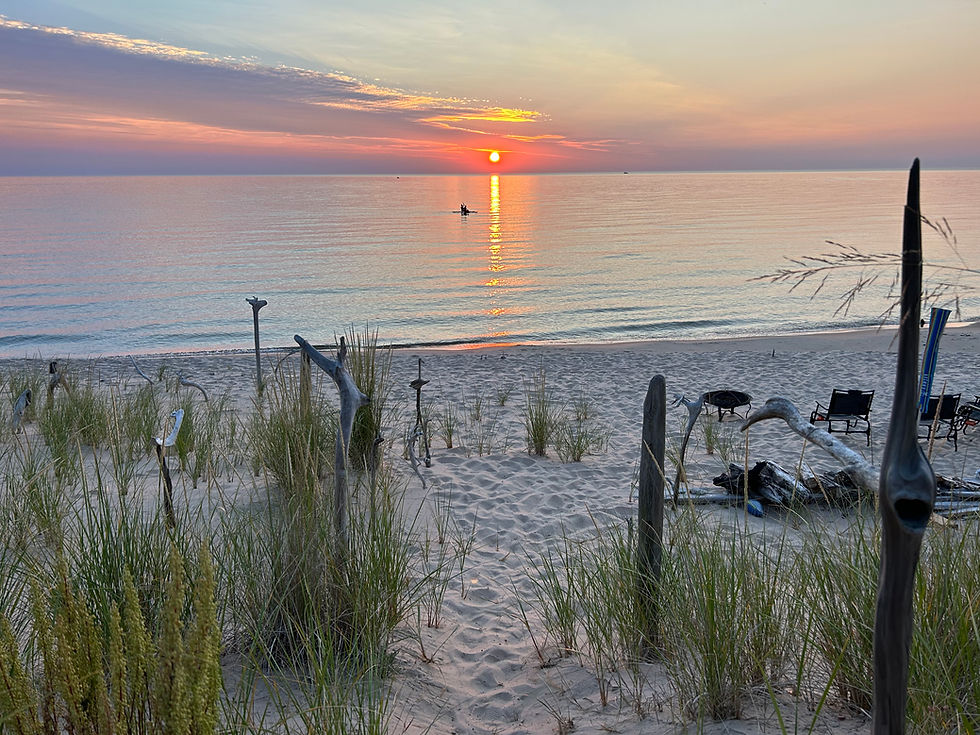
photo by Beth Van Oss - Lake Michigan
The blessed rain came down last night and woke me out of a deep sleep and this morning, I saw a Greater Roadrunner out my door here in northern Arizona. I love their sound, and watching them move through the landscape as they stalk for bugs and lizards always hopeful for a snake, I’m sure. Their long legs move quickly and deliberately like a Heron, and when something catches their attention, the feathers on top of their heads suddenly rough up as if to say, there is something amiss.
I have always been fascinated by those little shifts in the animals and landscape, although I don't think I always realized how much I was paying attention to them. I started noticing them more when I was an undergraduate student living up in the U.P. on Lake Superior. Growing up downstate, I knew Michigan, but living in the UP made me see it differently. In small ways, I began noticing the nuances of the landscape, the seasons, the trees, the weather, and the ways one part of the state gradually becomes another.
There is a place in Michigan called the Tension Zone, somewhere just south of Traverse City, where two very different ecological regions begin to meet. As you travel north, the landscape gradually changes, and White Birch trees, native to the northern part of the state, become part of the landscape a little north of Big Rapids. There isn't a hard line where one region ends and another begins; instead, there is a gradual shifting of one landscape into another.
I am a true Michigander and my husband always says, “You can take the girl out of Michigan, but you can’t take the Michigan out of the girl.” It doesn’t really matter that I have lived away from Michigan for a few decades. It is still in there.
There are places in life where we are no longer quite where we were, but we haven't yet arrived somewhere new, and I have certainly found myself in those spaces more than once. That is the transitional zone too.
During those times, I have found a strange kind of refuge in showing up for the things I normally do. I teach, I hike, I exercise, I keep learning, but there is often a heightened commitment to those activities because they give me something steady to return to when other parts of life feel less certain.
There is something grounding about continuing to show up when you don't have everything figured out. And perhaps there is something else happening there, too. People show up differently when something is at stake. We pay closer attention. We listen more carefully and become more willing to stretch ourselves because suddenly the outcome matters a little more.
I see this with many of my students, too, because so many people come toSpanish during a transitional time in their lives. They are traveling more, beginning something they have wanted to do for years, changing careers, moving somewhere new, entering a different stage of life, or simply realizing that there are still things they want to learn.
Learning a language puts you in another kind of transitional zone. You know some things, but there is so much you don't know. You understand more than you used to, which somehow makes you even more aware of what you still don't understand. You can have a conversation and then suddenly find yourself searching for one simple word or feel like you are making real progress one day and wonder the next whether you will ever feel completely comfortable speaking.
It can be frustrating to live in that space, but I have come to think that there is something valuable about it, too. We are often at our most attentive when we are standing at the precipice of something, when we know that change is possible but don't yet know exactly what that change will look like.
The great thing about transitions is that transformation is always possible. Something can shift.Something can emerge. We can become something we weren't expecting to become, often without realizing that the process is already underway.
A transitional zone isn't quite one place or the other, but rather the space where one thing is gradually becoming something else. Perhaps we spend too much of our lives trying to get through those spaces as quickly as possible, wanting to know what comes next before we have even had a chance to notice where we are.
That uncertainty is part of the experience, and it's worth considering if there is something to be learned by staying present long enough to see what happens.
I don't think we ever really finish becoming. So perhaps there is something worth paying attention to in the transitional zones of our lives, those places where we are learning, changing, wondering, beginning again, and not quite sure what the landscape will look like on the other side.
Because somewhere between one landscape and another, something changes. As I travel from the north to the south, the Birch, Eastern Hemlock and Jack Pines near Lake Superior become less dominant as I seethe Beech, Maple and Hemlocks on the sand dunes of Lake Michigan. The Sandhill Cranes have headed south. And here in my current landscape for today, the Cooper's Hawk swoops by causing the Titmice to flutter off to find refuge and the Greater Roadrunner has already moved beyond the protected scrub oaks. The landscape changes, something else moves in, and eventually we settle into a new way of seeing it. But there's always movement.


Comments